by Ken Meltzer
Published March 22, 2025
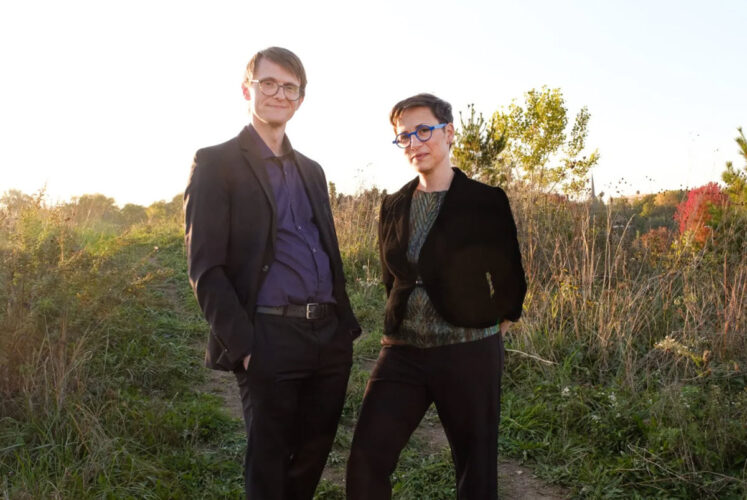
The Poet and the Prodigy, oboist Debra Nagy and harpsichordist Mark Edwards. Available on CD or digitally. Self-released by Les Délices.
The Poet and the Prodigy, surveying works by contemporaries J.S. Bach and François Couperin, is a recital by oboist Debra Nagy, founder and director of the Cleveland-based early-music ensemble Les Délices, and harpsichordist Mark Edwards, an ensemble regular who teaches at Oberlin Conservatory. In her liner notes, Nagy doesn’t explain the album’s evocative title, but writes: “can we determine who is the poet and who is the prodigy? Does it matter? Couperin and Bach were both extraordinary artists whose music gives us so much to contemplate and enjoy.”
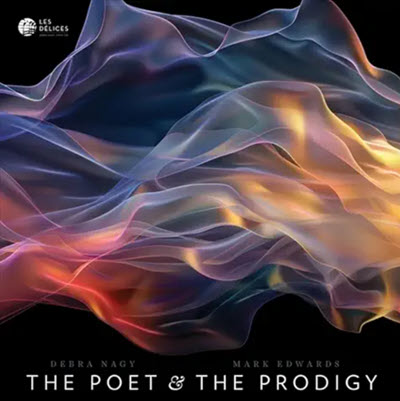
The Poet and the Prodigy is a celebration, first of the two composers who, for Nagy, “have been constant companions, continually inspiring and challenging me these past twenty-five years.” Second, the recital celebrates the mutual admiration and longstanding collaborations between Nagy and Edwards, noting that they “selected music that we absolutely love and ensured that the harpsichord serves as a true soloist and partner rather than accompanist.”
The program also reflects Bach’s and Couperin’s flexibility in adapting their works for various instruments. The program opens with Bach’s Sonata in G minor for Oboe and Harpsichord, BWV 1030b (a version of the Sonata for Flute and Harpsichord in B minor, BWV 1030). In the preface to the score for his Concerts Royaux, Couperin notes that his pieces “are suitable not only for the harpsichord, but also for the violin, flute, oboe, viol and bassoon,” and here the pair perform Couperin’s Premier Concert. The opening Andante from Bach’s Trio Sonata in D minor for Organ, BWV 527 “serves as a palate cleanser” for selections from Couperin’s Sixiême Ordre, inaugurating the composer’s Second Livre de Pièces de Clavecin.
Nagy and Edwards sequence the movements to alternate solo harpsichord with oboe/harpsichord duo (Prélude, Les Langueurs-Tendres, La Bersan, Les Bergeries, Les Baricades Mistérieuses, Le Moucheron). The Poet and the Prodigy concludes with Bach’s Concerto in C minor, BWV 1060. During his years in Leipzig, Bach created a version of the concerto for two harpsichords and strings, likely an arrangement of an earlier, Cöthen concerto for solo oboe and violin. Nagy and Edwards create a sort of hybrid, “a duo of oboe with harpsichord obbligato.”
The performances are superb. Playing a Baroque oboe made in 2004 by Randall Cook and styled after Jonathan Bradbury (London, c. 1720), Nagy offers flawless execution, impressive breath control, and elegant phrasing. Eschewing all vibrato, her timbre is consistently rich and attractive. In repeated episodes, Nagy provides delectable ornamentation, most impressively in the Siciliano of BWV 1030b, where her lovely and intricate decoration weaves seamlessly into the music’s fabric. Mark Edwards, performing on a Keith Hill harpsichord, modeled after Blanchet, is likewise impressive. The rich and detailed recorded sound accords oboe and harpsichord equal prominence. A marvelous recital.
Ken Meltzer was program annotator for the Pittsburgh and Atlanta Symphony Orchestras. He currently authors program notes for several U.S. orchestras, and reviews recording for various publications. For EMA, he recently reviewed The Butter Quartet, Spreading a Love of the Gallant.